Grandmother's Plate,
Doctor's Numbers
The 30-Day Nigerian Sugar Reset
How to build healthier eating habits around the Nigerian food you already know — without turning your family kitchen upside down.
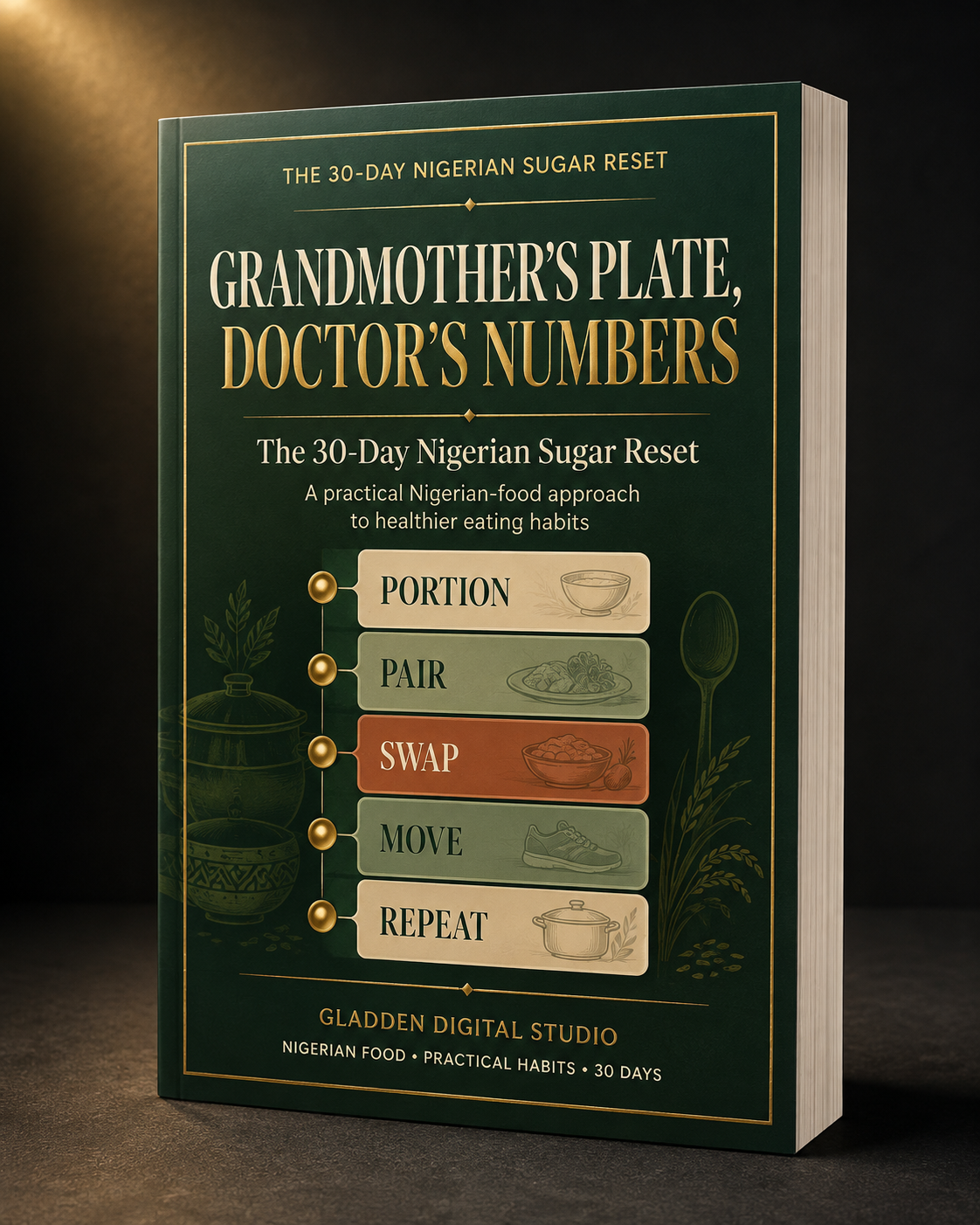
Doctor's Numbers
grandmothers-plate-main-ebook-mockup.png ]
Maybe the hardest part isn't knowing that you should eat better.
Maybe it's figuring out what "eat better" actually looks like when your kitchen is full of the food you grew up with.
Rice is rice. Beans is beans. Your mother's soup pot doesn't come with a nutrition label, and nobody at your work canteen is asking whether the eba portion is "appropriate." You already know the theory — smaller plate, more vegetables, less sugar in the tea. What nobody tells you is how that theory survives a Tuesday with three deadlines, a Sunday after church, a birthday owambe, or a house full of visitors who expect you to eat with them.
Most healthy-eating advice was written for a kitchen that isn't yours. It assumes quinoa is easy to find, that nobody minds if you skip the stew, and that "just cook at home" solves everything — as if home cooking in a Nigerian household isn't already rice, beans, plantain, soup and swallow, most days of most weeks.
This isn't a plan to make you eat differently from your family. It's a way to make more thoughtful choices with the food that's already on your table.
The problem isn't simply "Nigerian food."
It's rarely one ingredient. It's usually the pattern around the plate — how much lands on it, what sits beside it, what's in the cup, how often the body moves, and whether any of it holds up past day three. This guide organises those patterns into five parts you can actually apply.
Portion
Make portions more deliberate — without weighing every spoon of stew or turning dinner into a science experiment.
Pair
Build meals more thoughtfully by rethinking what sits next to the rice or the swallow, not by removing it.
Swap
Make realistic substitutions inside the meals you already cook, using ingredients you can actually find and afford.
Move
Build practical movement into an ordinary day — one that already has traffic, work, and family in it.
Repeat
Turn the first four into routine, so they hold up on the weeks when life doesn't cooperate.
Amaka's kitchen, and the question nobody was really asking

Amaka grew up in Enugu, in a kitchen that never really closed. She moved to Lagos for work, then to Ikeja for a shorter commute, and brought the kitchen with her — the same pots, the same Sunday jollof, the same instinct to feed anyone who walked through the door.
Somewhere in her thirties, "eat better" became a phrase she heard often — from a form at a routine check-up, from a colleague's WhatsApp broadcast, from her own reflection in the mirror before a wedding. She tried what everyone tries. She started Monday and stopped by Thursday. She cut out rice for two weeks and missed it more than she expected to. She bought a detox tea that promised a great deal and delivered very little except a smaller wallet.
People weren't necessarily asking for another lecture about healthy food. They were asking: "But what am I supposed to cook?"
That question is the one most guides skip. They're written by people who don't cook egusi for a family of six, who've never had to feed visitors on short notice, who assume a grocery run means a supermarket with everything in stock. Copying a generic Western meal plan onto a Nigerian week doesn't fail because Nigerian food is the problem. It fails because the plan was never built for this kitchen in the first place.
The shift, when it came, wasn't a new diet. It was a different question: stop looking for the perfect diet. Start looking for principles that can survive Nigerian life — the owambes, the extended family, the traffic, the Monday that doesn't go as planned. That shift is what this guide is built around.
Amaka's story is presented as a representative, composite account reflecting common experiences, not a documented individual case or a guaranteed outcome.
A realistic pace, not a punishing one
The Plate Audit
A honest, judgment-free look at what an ordinary plate looks like right now — the starting point everything else builds from.
One Pot, Different Plate
The same pot of soup or stew your household already cooks, served in a way that shifts the balance of the meal.
The Drink Check
A closer look at what's in the cup — often the easiest, least disruptive place to make a real change.
Stop Starting Over
Replacing the "start Monday" habit with a way to continue mid-week, after a missed day or an off plate.
Make It Ordinary
Turning the new choices into background habits, so they no longer take willpower to repeat.
Reduce Decision Fatigue
Building a small set of defaults for busy days, so there's less to decide when there's less time to decide it.
Review & Continue
Taking stock of what fit, what didn't, and what to carry forward into an ordinary month.
These are behavioural and practical milestones, not medical checkpoints. They describe habits you may build, not results you're guaranteed to see.
Inside Grandmother's Plate, Doctor's Numbers
81 pages, built to be used like a reference — not read like a novel. Most days, you'll only need one.
Welcome & How to Use This Guide
Why generic advice keeps failing, and the mindset shift this guide is built on.
Chapter 1: The Wake-Up Call
The honest starting premise: the plans failed you, not the other way around.
Chapter 2: The Plate Audit
A simple, honest starting exercise for your ordinary week — including your Quick Win.
Chapter 3: Nigerian Kitchen Protocol
How to apply Portion, Pair, Swap, Move and Repeat to the meals you already cook.
Chapter 4: The 30-Day Reset
A day-by-day walk-through built around real Nigerian routines, not a foreign template.
Chapter 5: Nigerian Food Swap Ladder
Realistic, affordable substitutions inside familiar dishes — no exotic ingredient lists.
Chapter 6: One Pot for the Whole Family
How to make small adjustments to your plate without cooking two separate meals.
Chapter 7: 15-Minute Movement System
Practical movement that fits around work, traffic and household responsibilities.
Chapter 8: Owambe & Christmas Survival Guide
A realistic approach to weddings, parties and the December season — without disappearing from the table.
Chapter 9: 30-Day Tracker
A simple way to follow your own progress through the reset, plus a second tracker for month two.
Chapter 10: Back-on-Track System
What to do after an imperfect day, so one off-plate doesn't become a lost month.
Chapter 11: When to Seek Professional Help
Guidance on when it's time to involve a doctor, dietitian or other qualified professional.
More than a PDF. A complete Nigerian-food system.
Your main guide plus practical bonus resources designed to make the system easier to use in real life.
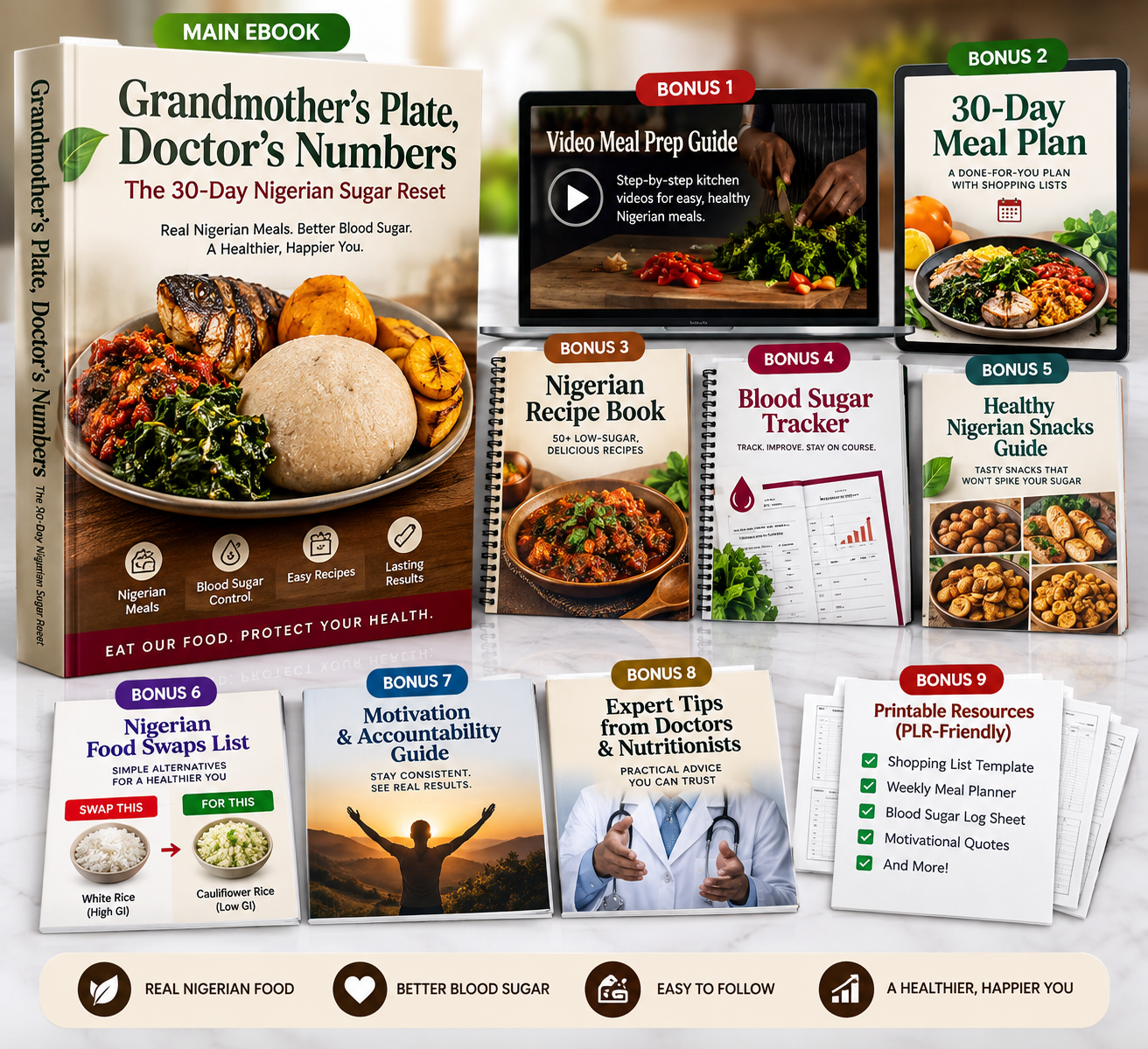
grandmothers-plate-bonuses-mockup.png ]
Everything you get today
Nigerian Food Swap Cheat Sheet
A one-page, fridge-worthy reference of realistic swaps for the dishes you cook most — for the days you don't have time to open a guide.
Owambe & Christmas Survival Guide
Because your social calendar isn't going anywhere — a practical, slightly playful guide to parties, weddings and the December season.
7-Day Nigerian Shopping List
A ready-made list built around ingredients you can actually find at your local market, so planning takes minutes, not an evening.
Family Plate Planner
A simple tool for planning meals the whole household eats together — no separate pot, no separate plate.
What people are saying
"The biggest thing for me was learning that I didn't have to cook another meal entirely. I could eat what the family was eating and simply pay more attention to my own portion and what I put around it. That made the whole thing much easier."
"Before this, every healthy eating plan I found felt like something made for another country. The Nigerian food examples made it much easier for me to understand what I could actually do at home."
"I liked the practical side. No long theory. I could look at my normal meal and immediately understand what I could change. The Plate Audit was especially helpful."
"The Owambe section was honestly my favourite 😂. Nigerian social events are part of life, so telling people to just avoid everything isn't realistic. I finally have a way to think about those occasions."
"I have tried starting different eating plans several times and usually stop after a few days. What I liked here was the Back-on-Track section. One bad meal doesn't mean you have failed the whole week."
"The food swap guide made sense because these are foods we actually eat. I didn't need to go and buy expensive ingredients before I could start."
"I appreciated that the guide didn't make me feel like Nigerian food is the problem. It showed me how to make more thoughtful choices with the food already available to me."
"The family meal approach is what made me buy it. I don't have the time to prepare different meals every day. Having one main family meal and understanding how to construct my own plate is much more realistic."
"Living in the UK, I found a lot of the meal plans online very disconnected from the food I grew up eating. This one felt familiar. I could actually picture the meals in my kitchen."
"I bought this because I wanted something that understood Nigerian food instead of telling me to completely change what I eat. The family-meal approach has been the most useful part for me."
"I still cook Nigerian food regularly even though I live abroad. The guide helped me think differently about portions and meal combinations without feeling like I had to give up the food I enjoy."
"I have downloaded plenty of generic meal plans before. What made this different was the cultural context. It actually talks about the foods my family eats."
"The social-event section really spoke to me. Even though I'm abroad, Nigerian parties are still Nigerian parties 😂. I liked having practical strategies instead of an unrealistic list of things I shouldn't touch."
Questions people actually ask
No spin here — just honest answers to the things you're probably wondering right now.
I've tried meal plans before and none of them stuck. Why would this be different?
Because it was never a discipline problem. Every plan you've tried probably assumed you'd stop eating rice, eba, or the food your family already cooks — so it fell apart the moment real life showed up. This guide starts from the opposite place: it's built entirely around the meals you already make, with small, realistic shifts instead of foreign substitutions. Nothing to eliminate, nothing to hide from your family.
81 pages sounds like a lot. Do I have to read it all before I start?
No. Chapters 1 to 3 give you the full foundation — after that, the guide works as a reference you dip into as needed: the Swap Ladder before you cook, the Owambe chapter before an event, the Back-on-Track System the moment an off day happens. Most readers start applying the first idea within their first 20 minutes, using the Plate Audit in Chapter 2.
I cook for my whole family, not just myself. Will this actually work for me?
Yes — this is exactly who Chapter 6 (One Pot for the Whole Family) is built for. You keep cooking the same meal, at the same volume, for everyone. The only thing that changes is how you personally serve your own plate, which is a private decision nobody else at the table needs to know about.
Do I need to buy special or expensive ingredients?
No. Every swap in the guide, from Tier 1 through Tier 3, uses ingredients available at a normal Nigerian market or local supermarket. Nothing here requires a specialty store, and most of the easiest shifts cost nothing extra — they're changes in portion or preparation, not new shopping lists.
I have a wedding, owambe, or Christmas coming up. Won't that ruin everything?
No — that's specifically what Chapter 8 and your bonus Owambe & Christmas Survival Guide are built for. Nothing here asks you to skip a celebration or bring your own food to a party. You'll get a real, practical strategy for weddings, parties, and the December season without disappearing from the table.
Will this guarantee weight loss or a specific health outcome?
No, and we won't pretend otherwise. This is an educational guide about food habits and portion awareness — not medical advice, and not a promise of a specific number on a scale or a specific blood sugar reading. Chapter 11 is dedicated entirely to helping you know when it's time to involve a doctor or dietitian instead of a guide.
I live outside Nigeria. Is this still useful for me?
Yes. Every principle in this guide travels with the food, not the location — if you're still cooking jollof, egusi, or eba wherever you are, the same swaps and portioning logic apply. Many readers in the diaspora say this is the first guide that didn't ask them to abandon Nigerian food just because they'd moved abroad.
What if I buy it and it's genuinely not useful to me?
Then request a refund within 7 days of your purchase — no drama, no guilt. Email theresourcehub.co@gmail.com with your order details. This guide is built to be practical from day one, and it's meant to be judged on whether it's actually useful to your real life, not on how convincing the sales page was.
Start with your next plate for ₦8,900.
- The complete 11-chapter system (81 pages you'll use, not cram)
- Nigerian Food Swap Cheat Sheet
- Owambe & Christmas Survival Guide
- 7-Day Nigerian Shopping List
- Family Plate Planner
to decide
7 days to decide whether this guide is useful to you.
Grandmother's Plate, Doctor's Numbers is an educational digital product. It's built to be practical from day one — if it isn't useful to you, request a refund within 7 days of purchase.
You don't need all 30 days to know if this guide was built for your kitchen. Most readers know within the first chapter or two — the Plate Audit alone, in Chapter 2, is usually enough to tell you whether this approach fits your real life.
- This guide is educational, not medical advice.
- It does not replace professional medical care, testing or diagnosis.
- No specific blood-sugar reading or weight-loss outcome is promised.
- Refunds available within 7 days — email theresourcehub.co@gmail.com with your order details.
Either way, the choice is yours.
Option 1 — Close this page.
Nothing changes today. Your kitchen stays exactly as it is, and you're welcome to come back to this page whenever it feels like the right time. There's no penalty for waiting.
Option 2 — Start with your next plate.
You can begin building a routine that fits the life you already live — the same rice, the same soup, the same family table, approached a little more deliberately.
Start the Reset — ₦8,900P.S. — This isn't a lecture and it isn't a diet you'll abandon by Thursday. It's a practical system for the meals you're already cooking, built around portions, pairings, swaps, movement and repetition you can actually keep up.
P.P.S. — ₦8,900 is the current launch price. It reflects where this guide is right now, not a countdown or a trick — the price may change as the guide grows.
Maybe it's to become the person who knows how to make better decisions with the food she already has. Start with the next plate.